


di Caterina De Vivo
ABSTRACT: This article aims to discuss some issues concerning the archaeological museum and how it relates with the territory and the public. Archaeological site museums in particular will considered – that is those closely connected to an archaeological site – in order to demonstrate trough the U.K. example, how this kind of museum that best increases awareness of the importance of the conservation of archaeological and historical heritage.
Archaeology in context
In 1964 with the Venice Charter ICOMOS[1] declared that a “A monument is inseparable from the history to which it bears witness and from the setting in which it occurs”[2], thus emphasizing the importance of connecting the historical sites and the monuments with the culture of the place where they are located. The Venice Charter aims to protect all kinds of monuments, but the same idea was even more clearly expressed by ICOMOS in 1990 (Losanna Charter), referring in particular to the archaeological sites, with the declaration that “the overall objective of the cultural heritage management should be the preservation of monuments and sites in situ”[3].
In the last few years, the importance of not only tangible heritage (eg. Monuments, buildings) but also intangible heritage has been stressed by the international community, and substantiated by the UNESCO Istanbul declaration of 2002 which reiterated that in preserving objects and site from the past, the relation between tangible and intangible meaning has to be considered[4]. The intangible meaning that lies behind each object and which is essential if misconceptions and misinterpretation in the exposition of historical objects has to be prevented. The principle expressed by those international documents are particularly interesting if we think of the many archaeological sites and the common practice of removing materials from them to place them in museums elsewhere. But understanding the relationship between the site and its object is crucial point in understanding the role of archaeological site museums in preserving the past.
The main problems with the exposition of archaeological finds in museums are, firstly, that they are often designed and planned to merely put the objects on display, giving visitors the perception of living an aesthetic experience rather than a historical one; and secondly, underestimating the importance of targeting a particular section of the public[5]. This problem is particularly relevant to archaeological museums exhibiting objects from the classical rather than the prehistoric period. The aim should be not only to prevent misinterpretation on what is displayed, but also to not make it difficult to perceive the cultural meaning inherent in the objects, since the result is often that they are taken for “art-pieces”, when they are in fact objects that “simply tell the story” of the civilization that produced them[6].
A more stimulating solution to the problem of relating archaeological finds to a history and a specific culture rather than “reducing” them to “art-pieces” is to link them to the sites they come from, thus maintaining the strong between site-culture-object connection. At the same time, a site museum designed and planned with these goals in mind can add value and interest to an archaeological site, especially for a non-expert public that otherwise might find it difficult to understand and appreciate it.
The U.K example: the Roman site museums
When analyzing the issues connected to the role of the archaeological site museums, the U.K. example is really interesting. Completely in accordance with the principle of the Losanna Charter, in 1990 with the PPG 16[7] Law, the need was clearly expressed to preserve archaeological sites in situ, and to keep the artefacts in local museums to contextualise them and promote a deeper awareness of their significance. For this reason, most British archaeological sites are linked to a particular local museum, if they don’t have their own site museum.
In the general panorama of the British sites, the Roman ones is the most interesting. As a matter of fact, the U.K. is one of the countries in Europe where public response to archaeology and archaeological sites has been more enthusiastic, although, admittedly, the Roman sites are not as popular as are the prehistoric or Saxon ones[8]. As Maria Clara Ruggieri Tricoli suggested this lack of interest of the British in their Roman past is probably due to the feeling the Romans were just invaders, and that British historical heritage is more closely connected to the Saxon past. As Ruggieri Tricoli reminds us, it is amazing that in the Reading Museum (Reading, Berkshire) the city’s Roman origins were completely ignored, and its history was only told only from 600 A.D., when it was founded by the Saxons. In 1995, when the new Silchester Gallery was opened, the city’s Roman history was finally included in the museum . This phenomenon of “ignoring” the Roman past has ancient roots: in the Ancient Monument Protection Act of 1882, the first real document for the protection of the archaeological sites in the U.K., no Roman site was included[9]. It is also true that, historically, the British Archaeological tradition was more focused on Prehistoric sites, considering the British Roman sites as “second order” in comparison with the Italian or the Southern European ones. At the same time, the Saxon, Celtic and Prehistoric sites were more associated with the “foundation” myths of National identity[10]; also for this reason these sites might have been more appealing to the British public.
However, there are examples that show how, since the end of the late 1980’s, the new museums designed and planned with developing public interest and awareness in mind, have brought new life to the Roman sites
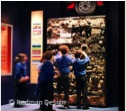
One of the most interesting cases is the one of Wallsend, in northern England, where the Segedunum site is located. This site is linked to the ambitious project regarding the museification of Hadrian’s Wall. The project began in 1993, after Hadrian’s Wall had become a UNESCO World Heritage Site. The project created in the area around the Wall 10 museums and attracted over 1 million of visitors per year[11]. At Wallsend a museum was opened in June 2000 next to the ruins, and it had about 80.000 visitors only in the first year[12]. A 35 m. high tower has been so that visitors can observe the site directly from the museum; interactive systems inside the museum explain the history of the site and enlighten the public about the meaning and the cultural background of every single object preserved in the museum. At the same time, visitors have the chance to understand the meaning of archaeology, and how each little piece of the past builds part of our history. Thanks to the presence of a “stratigraphy” wall. Near the site the reconstruction of a Roman building gives visitors an idea of what the life of common people was like in Roman times[13]. The interactive tools are particularly useful in such a site, that is historically important, but not easy to interpret for a “non-archaeologist” visitor, because this is not a site where everything is so well preserved that is perfectly clear what each little remaining part of a wall was. And perhaps this was the reason for the public’s lack of interest. As is shown by the number of visitors people-friendly museums arrangement can change the public’s point of views.

The interactive design of the museum with its cutting edge technologies that won 11 awards including the Association for Heritage Interpretation Special Judges Award[14], was the work of design team Redman Design that declared: “At Wallsend the challenge was to bring this famous Roman fort to life, when so little remains visible on the surface”[15]. This declaration explain clearly how the intention was not just to show the site, but to bring the history back to life. This philosophy is showed by the construction of a imitation stele on which the name of the “builders of the wall” have been written. The names are all local names collected in the area from various archaeological remains; giving a name to the “ancestors” is one way of letting visitors realize that a visit to an archaeological museum can also be an “emotional” experience.
Another good example of site museification is Caerleon, in Wales, built in 1987. It is also a site where there was a Roman Fort. Here it is possible to visit the remains of military barracks and the National Museum of the Roman Legionary, with its didactic centre where children pretend to be young legionaries. And in the museums, the exhibits are displayed showing visitors what they were used for with models legionaries set in life-like scenes. The mosaics floors have been left as they were with containers and receptacles on them, giving the idea that the mosaic are not on show as an “art piece” and emphasizing the original meaning. In 2008 a Roman garden was added outside the museum to show people all the plants the Romans brought to Great Britain. Another way of letting visitors fell “closer” to the their ancestors[16]. This fairly young museum is also reasonably successful: in 2011 it had approximately 70.000 visitors[17].
It is also interesting to know that in both the museums re-enactment on the sites are organized. These two sites museums are just two examples of the many successful Roman sites that have been restored in the last few years[18].
Conclusion
The U.K. example of the success of the site museums is probably due to the fact that they managed to really contextualize museums exhibits in the territory, relating them to specific places and the local culture. At the same time, the history of the sites explained trough interactive system and interactive installations becomes for the visitor a fascinating and enjoyable experience. And it is probably not by chance that the U.K. is the homeland of the post-processualist studies in archaeology[19]. The post-processualist movement, started in the 80’s arguing the importance of contextualising archaeological objects if their “intangible” meaning is to be understood[20]. It is by respecting this philosophy that the U.K. sites museum have been able to turn the archaeological museums into a really “historical experience” helping people to better understand their past. What is also really important is the general impression that these museums seem to be built not only for tourists, but also for the local inhabitants, creating a strong link between ancient and living culture. This tendency, however, is spreading all around Europe, also thanks to the support of the International Council of Museums and the European Community, as has been shown by the success of the project Livearch, which promoted the “living” history of archaeological museum; the follow-up to the project was Exarc, an association of living history museums, where the past is not just displayed, but brought to life[21].
Unfortunately in a context where the archaeological museums show objects that are, in fact, pieces of art, like all the classical archaeological museum in Italy, it is still difficult to combine a more public-friendly setting with the respect of the exhibits; the consequence is that when before the archaeological museum exposition visitors are often more passive. However, some positive examples are now appearing also in the classical Italian context. One good example is the MAV[22] of Herculaneum, where it is possible to go on a virtual tour of the ancient town before entering in the real archaeological site; another good example is the Hera Argiva Museum in Paestum. In this case the interactive museum is indispensable for clearly showing the history of the very important archaeological site that without the museum would probably be difficult to understand for a non expert public; however, through its several interactive tools, the museum manages to create a close link also with the present living culture of the territory[23].
To conclude, even if some might argue that site museums are sometimes too children-orientated and show more reconstructions than real objects, it has to be said that the great advantage of interactive site museums is that they are public-orientated and create that vital connection with the territory, as the recent success of the U.K. site museums has shown. The consequences can be seen in that not only does the number of visitors increase, but also they help people really understand what they are visiting and, hopefully, increase people’s awareness of how important it is to preserve and conserve the past.
Images
1. The “stratigraphy wall” from Segedunum Roman Fort & Bath House, Wallsend. For kind concession of the Redman Design:http://www.redman-design.com/#/projects/segedunum-roman-fort-and-bath-house
2. Interactive hall from the Segedunum Roman Fort & Bath House, Wallsend. For kind concession of the Redman Design:http://www.redman-design.com/#/projects/segedunum-roman-fort-and-bath-house
Bibliography
- Bouchenaki, B. 2005. Place – memory – meaning: preserving intangible values in monuments and sites, in Keynote address of the XIV General Assembly of the ICOMOS;
- Cipriani, M. 2009. Nuove Tecnologie e Pubblico: alcune considerazioni sul sito di Paestum, in L’archeologia e il suo pubblico, edited by Adriano La Regina, Firenze, Giunti Editore;
- Hodder, I. 1986. Reading the past, Cambridge University Press;
- La Regina, A. 2009. L’Archeologia e il suo pubblico, Firenze, Giunti Editore;
- Mgomezulu G.G.Y. 2004. Editorial of Museum International – The site museum, Vol. LVI, n°3/223, 2004;
- Pomian, K. 1990. Collectors and Curiosities. Cambridge, Polity Press;
- Planning Policy Guidance, 16. Archaeology and Planning, U.K. Governmental Law (1990); articles 13, 14, 25, 27;
- Ruggieri Tricoli, M.C. 2007. Musei sulle rovine – architetture nel contesto archeologico, Milano Lybra Immagine Edizioni;
- Trigger, B.G. 2006. A History of Archaeological Tought (2° edition), Cambridge University Press.
Web Sources
- Ancient Monuments Protection Act 1882. http://www.parliament.uk/about/living-heritage/transformingsociety/towncountry/landscape/overview/historicsites/. Retrievedon April 30th 2012.
- http://exarc.net/. Retrieved on 30th April 2012;
- http://www.hadrians-wall.org/page.aspx//Supporting-Our-Work/Hadrian-AD2022.Retrived on April 30th 2012.
- http://www.newsguardian.co.uk/news/local/praise_for_museum_run_by_passion_1_1602468#. Retrieved on April 30th 2012.
- http://www.twmuseums.org.uk/segedunum/. Retrievedon April 30th 2012;
- http://www.redman-design.com/#/projects/segedunum-roman-fort-and-bath-house. Retrieved on April 30th 2012;
- http://www.museumwales.ac.uk/en/roman/. Retrieved on April 30th 2012
- http://www.culture24.org.uk/history%20%26%20heritage/time/roman/art61081. Retrievedon April 30th2012.
References
[1]ICOMOS is the InternationalCouncil on Monuments and Sites, it is part of the UNESCO. Its institution was in 1964.
[2]ICOMOS International Charter for the Conservation and Restoration of Monuments and Sited (Venice Charter), article 7; 1964. See http://www.international.icomos.org/charters/venice_e.pdf. Retrieved on May 30th 2012
[3]ICOMOS Charter for the Protection and Management of Archaeological Heritage (Losanna Charter), art. 6; 1990. See http://www.international.icomos.org/charters/arch_e.pdf. Retrieved on May 30th 2012.
[4]Bouchenaki, B. 2005. “Place – memory – meaning: preserving intangible values in monuments and sites”. In keynote address of the XIV General Assembly of the ICOMOS.
[5]La Regina, A. 2009. “L’Archeologia e il suo pubblico”. Giunti editore.
[6]Pomian, K. 1990. Collectors and Curiosities. Cambridge: Polity Press.
[7]Planning Policy Guidance, 16: Archaeology and Planning, U.K. Governmental Law; articles 13, 14, 25, 27. 1990.
[8]Ruggieri Tricoli, M.C. 2007. Musei sulle rovine – architetture nel contesto archeologico. Lybra Immagine Edizioni.
[9]Ancient Monuments Protection Act 1882. http://www.parliament.uk/about/living-heritage/transformingsociety/towncountry/landscape/overview/historicsites/. Retrievedon April 30th 2012.
[10]Trigger, B.G. 2006. A History of Archaeological Tought – 2° edition. Cambridge University Press.
[11]http://www.hadrians-wall.org/page.aspx//Supporting-Our-Work/Hadrian-AD2022.Retrived on 30th April 2012.
[12]http://www.newsguardian.co.uk/news/local/praise_for_museum_run_by_passion_1_1602468#. Retrieved on April 30th 2012.
[13]http://www.twmuseums.org.uk/segedunum/. Retrievedon April 30th 2012.
[14]U.K. is one of the few country which has awards for museums settings and archaeology, showing the great interest that is around this topic.
[15]http://www.redman-design.com/#/projects/segedunum-roman-fort-and-bath-house. Retrieved on April 30th 2012.
[16]http://www.museumwales.ac.uk/en/roman/. Retrieved on April 30th 2012
[17]http://www.culture24.org.uk/history%20%26%20heritage/time/roman/art61081. Retrieved on April 30th2012
[18]Ruggieri Tricoli, M.C. 2007. Musei sulle rovine – architetture nel contesto archeologico. Lybra Immagine Edizioni.
[19]Hodder, I. 1986. Reading the past. Cambridge University Press.
[20]Mgomezulu G.G.Y. 2004. Editorial of Museum International – The site museum. Vol. LVI n°3/223, 2004. Blackwell Publishing.
[21]http://exarc.net/. Retrieved on 30th April 2012.
[22]http://www.museomav.it/. Retrieved on 2nd May 2012.
[23]Cipriani, M. 2009. “Nuove Tecnologie e Pubblico: alcune considerazioni sul sito di Paestum”. In L’archeologia e il suo pubblico. Edited by Adriano La Regina, Giunti Editore.


